You have a website. You have a good product or service. You may even have a decent social media presence.
But still, the phone is not ringing as much as you expected.
So you try Google Ads.
For a few days, people start visiting your website. You get some calls or enquiries. But then you look at the ad spend and think:
“Am I spending too much for these customers?”
Then someone tells you to invest in SEO.
You hear that SEO can bring customers from Google without paying for every click. That sounds great. But then another question comes up:
“How long will I have to wait before SEO actually brings customers?”
This is the real problem many small businesses face today.
You have a limited marketing budget, and you cannot afford to spend months or thousands of rupees on something without knowing whether it will work.
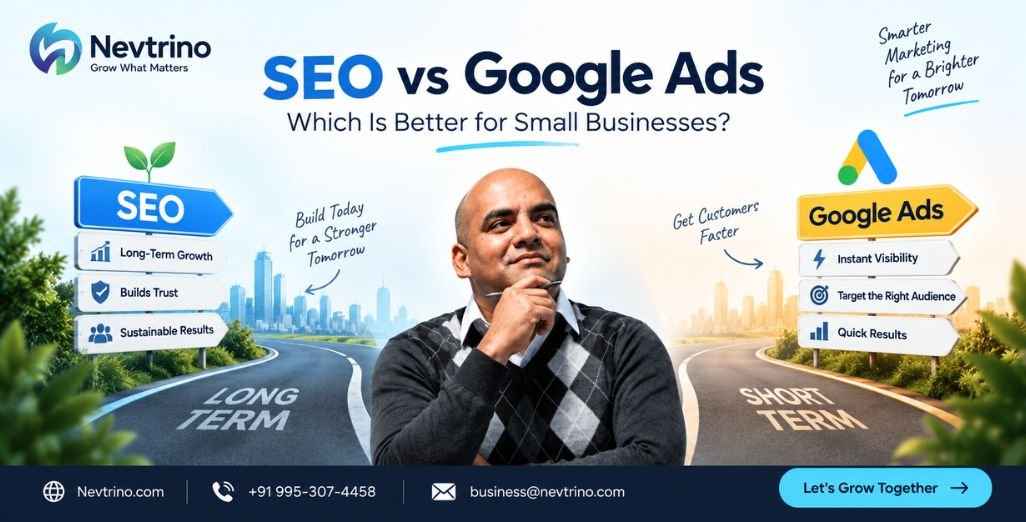
So, when comparing SEO vs Google Ads, which one should you choose?
The answer is not simply SEO or Google Ads. It depends on what your business needs right now.
In this blog, we will break down SEO and Google Ads in simple terms, compare their costs, results and long-term value, and help you understand which option makes more sense for your small business.
SEO vs Google Ads: What Is the Actual Difference?
Let’s keep it simple.
SEO helps your website appear in Google’s organic search results without paying Google for every click.
Google Ads works differently. You pay to show your advertisement to people searching for specific products or services.
For example, imagine you run a home interior business in Pune.
Someone searches:
“2 BHK interior designer in Pune”
If your website appears naturally in the search results, that is SEO.
If your advertisement appears at the top of the search results, that is Google Ads.
Both can bring the same customer to your business. The difference is how you get in front of them.
The Biggest Advantage of Google Ads: Speed
Let’s say you have just launched a new business.
You cannot always wait months hoping Google will eventually start sending customers to your website. You have rent, salaries, suppliers and other expenses to manage.
This is where Google Ads can be useful.
You can create a campaign around searches that are relevant to your business and start getting visibility much faster than you normally would through SEO.
For example, if you provide AC repair services in Delhi, someone searching for “AC repair near me” may need your service right now.
If your ad appears at that moment, you have an opportunity to get the call.
This is why Google Ads for small business can make sense when immediate leads or sales are important.
But there is one important catch.
Google Ads does not mean every click will become a customer.
You can get clicks and still lose money if your targeting, website, pricing, offer or follow-up process is poor.
The Biggest Advantage of SEO: It Can Keep Working
Now imagine you have created a useful page about one of your services.
You optimize it properly, improve your website and build its authority.
It starts ranking on Google.
You may then receive visitors without paying Google for each organic click.
That is the attraction of SEO.
However, SEO is not instant.
You may need to spend months improving your website and creating useful content before you see significant results, especially if you are competing against established businesses.
This is why SEO for small business is usually better viewed as a long-term investment rather than a quick marketing trick.
SEO vs Google Ads Cost: Don’t Look Only at the Monthly Bill
This is where many business owners make the wrong comparison.
Suppose Business A spends ₹30,000 on Google Ads.
Business B spends ₹30,000 on SEO.
It is tempting to ask which one is cheaper.
But that is not the right question.
Instead, ask:
How many customers did each one generate?
Imagine the Google Ads campaign generated 30 customers.
The SEO work generated 10 customers in the same period.
At first, Google Ads looks better.
But six months later, the SEO pages are bringing 50 customers every month while the business is still spending heavily on ads.
Now the calculation looks very different.
This is why SEO vs Google Ads cost should always be considered over a longer period, not just one month.
SEO vs Google Ads Results: Which One Should You Expect First?
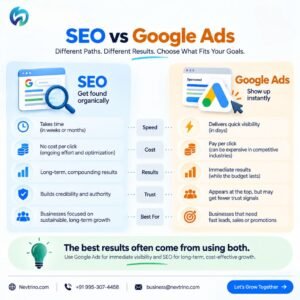
If you need results quickly, Google Ads usually has the advantage.
If you are trying to build a reliable source of organic traffic, SEO usually needs more patience.
Think about it like this:
Google Ads can help you get visibility quickly.
SEO can help you build visibility over time.
When you stop your Google Ads campaign, your paid visibility normally stops.
With SEO, a page that has earned strong organic visibility can continue attracting visitors after the initial work is complete.
That does not mean SEO is free or that rankings are permanent. Google rankings can change, competitors can improve and your website still needs maintenance.
But the value of SEO can continue beyond the month in which you invested in it.
What About Google Ads vs SEO ROI?
This is probably the question you really care about.
Which one makes more money?
There is no universal answer.
A business selling a ₹500 product cannot approach Google Ads in the same way as a business selling a ₹2 lakh service.
The same applies to SEO.
If one customer is worth ₹1 lakh to your business, spending ₹5,000 to acquire that customer may make sense.
If your average sale is ₹500, your marketing numbers need to look very different.
Before choosing between SEO and paid advertising, calculate:
- Average order value
- Profit per customer
- Cost of acquiring a customer
- Number of leads needed for one sale
- Customer lifetime value
- Monthly marketing budget
This gives you a much clearer picture of SEO vs Google Ads ROI.
When Google Ads Makes More Sense
Google Ads may be the better choice if:
- You need customers quickly
- You have a new business
- People are actively searching for your service
- You have a profitable product or service
- You can track leads and sales properly
- You have enough budget to test and optimize campaigns
For example, a local emergency plumber may benefit more from paid search than spending months creating blog content.
The customer has a problem today.
The business needs to be visible today.
When SEO Makes More Sense
SEO may be a better investment if:
- You want long-term traffic
- Your customers regularly search for your services
- You want to reduce dependence on paid advertising
- You have useful information that people are searching for
- You are building a long-term brand
- You can wait for organic growth
For example, a travel company can create useful pages around destinations, travel guides and frequently searched questions.
Those pages can continue attracting potential customers long after they are published.
What If You Are a Small Business in India?
For SEO vs Google Ads in India, your location and competition matter a lot.
A local business in Bhubaneswar targeting searches for a specific service will have a very different situation from an ecommerce company trying to sell across India.
Your competition, customer value, location and search demand all affect the decision.
This is why copying another company’s Google Ads budget or SEO strategy usually does not work.
A ₹20,000 monthly budget may be enough for one local business to test Google Ads, while another business may need much more because of high competition.
The same applies to SEO.
Start with your own numbers, not someone else’s.
SEO vs Google Ads for Small Businesses in India
Small businesses in India often have another challenge: they need to make every rupee of their marketing budget count.
A local restaurant, salon, coaching centre, real estate company and B2B service provider will all have different customer journeys.
For example, a person searching for “best salon near me” may be ready to book an appointment today.
But someone searching for “how to choose the right accounting software” may still be researching.
This means your marketing strategy should match the customer’s intent.
Google Ads can be particularly useful for high-intent searches where people are ready to take action.
SEO can be useful for reaching people earlier in their research and building visibility around the questions, services and products related to your business.
Instead of asking which channel is better for every business, ask which channel is better for your customer’s buying journey.
What If You Can Use Both?
You do not always have to choose between SEO and Google Ads.
For many businesses, using both can actually be a practical approach.
You can use Google Ads to generate immediate traffic and leads while SEO works in the background to build organic visibility.
For example, a local service business could run Google Ads for its most important services while also improving its service pages and creating useful content for organic search.
After a few months, you can compare the actual results.
Which channel generated more qualified enquiries?
Which brought customers at a lower cost?
Which customers generated more revenue?
That data can help you decide where to increase or reduce your budget.
A Practical Example
Let’s say you run a digital marketing agency in India.
You want 20 new enquiries every month.
Instead of immediately spending your entire budget on one channel, you could test Google Ads for high-intent searches while working on SEO pages targeting your important services.
After a few months, you might discover that Google Ads is generating enquiries quickly but at a higher acquisition cost.
At the same time, your SEO pages may be starting to generate enquiries at a lower long-term cost.
Now you have real data to make a decision.
That is much better than choosing SEO or Google Ads simply because someone told you one is “better.”
Should I Invest in SEO or Google Ads?
If you are still confused about SEO or Google Ads, use this simple rule.
Need customers now? Start by testing Google Ads.
Want to build long-term visibility? Invest in SEO.
Have enough budget? Consider using both.
But before spending money, make sure you know what you are trying to achieve.
Do you need phone calls?
Website enquiries?
Online purchases?
Bookings?
Brand visibility?
The answer can change which marketing channel makes the most sense.
Final Thoughts
There is no universal winner in the SEO vs Google Ads debate.
Google Ads can help you reach potential customers quickly. SEO can help you build an organic presence that can continue bringing visitors over time.
If you have a limited budget, start with the channel that matches your immediate business goal instead of trying to do everything at once.
And if your business is growing, combining SEO and Google Ads can give you both short-term opportunities and long-term growth.
The real question is not:
“Which one is better?”
It is:
“Which one makes more sense for my business right now?”
Once you answer that, it becomes much easier to decide where your marketing budget should go.
Because at the end of the day, the winner is not the channel that gives you the most clicks.
It is the channel that helps you get more customers and grow your business profitably.