
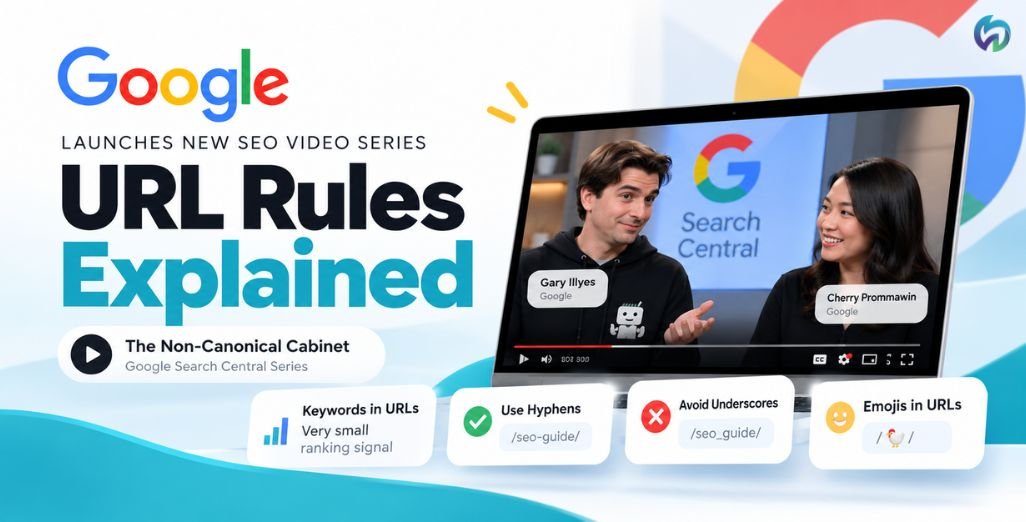
Google has introduced a new Search Central video series called The Non-Canonical Cabinet, designed to answer unusual technical SEO questions that website owners and SEO professionals may encounter.
The series debuted with a teaser on October 6, 2026, followed by its first episode on October 14, 2026.
Hosted by Google’s Gary Illyes and Cherry Prommawin, the first episode explores what characters are allowed in domain names and URL paths, how Google handles emojis and non-English characters, and whether adding keywords to URLs helps websites rank.
One of the most important takeaways concerns a familiar SEO practice: using target keywords in website URLs.
According to Illyes, keywords in URLs provide an extremely small ranking signal, particularly when Google already has sufficient information about a page’s content.
For website owners who spend time optimizing URL slugs, the clarification provides a useful reminder that descriptive URLs matter, but keyword-heavy URLs should not be mistaken for a significant ranking advantage.
Here’s what Google discussed and what the guidance means for your website.
What Is Google’s New Non-Canonical Cabinet Series?
The Non-Canonical Cabinet is a new video series published through Google Search Central’s YouTube channel.
Rather than focusing entirely on introductory SEO concepts, the series addresses unusual technical questions about how search systems interact with websites.
Its format is intentionally lighthearted, but the subjects involve genuine technical considerations that website owners, developers, and SEO professionals may encounter.
The first episode focuses on the rules governing domain names and URL paths.
These topics may seem relatively minor, but understanding them can help businesses avoid unnecessary website changes and make better decisions when launching or maintaining web pages.
Google previously published a five-part series called How Search Works in 2024, which explained crawling, indexing, and serving search results.
The new series takes a different approach by exploring specific questions and unusual scenarios.
Google Says Keywords in URLs Have Very Little Ranking Impact
One of the most notable explanations in the first episode concerns the ranking value of keywords in URLs.
Many website owners believe that including an exact target keyword in a URL can significantly improve their Google rankings.
For example, someone targeting the search term “digital marketing services in Dehradun” might create a URL such as:
example.com/best-digital-marketing-services-in-dehradun
A descriptive URL is not inherently a problem. However, adding more keywords does not mean the page will receive greater visibility.
During the episode, Gary Illyes described the ranking signal from URL keywords as extremely small.
He explained that the signal becomes particularly unimportant when Google has other information available to understand the page.
What Does This Mean for SEO?
Consider these two URLs:
URL A: example.com/seo-services-dehradun
URL B: example.com/best-professional-affordable-top-seo-services-dehradun
The second URL contains more promotional keywords, but that does not make it more likely to rank.
The first is shorter, easier to read, and communicates the page’s subject without unnecessary repetition.
Google’s explanation reinforces an important principle: a URL should help people understand where a link leads rather than attempt to manipulate search rankings through repeated keywords.
This does not mean descriptive URL words are useless. They can still improve readability, make links easier to understand, and communicate the page’s topic.
The key distinction is between using useful descriptions and expecting URL keywords to provide a meaningful ranking advantage.
Google Recommends Hyphens Instead of Underscores in URLs
The episode also addresses a familiar technical SEO question.
Should website owners separate words using hyphens or underscores?
Google continues to recommend hyphens.
For example:
Recommended: example.com/google-seo-guide
Not recommended: example.com/google_seo_guide
According to Google’s documentation, hyphens help users and search engines identify individual concepts within a URL.
Underscores have historically been used in programming and other technical contexts to connect related terms.
Gary Illyes also explained that Google may interpret underscore-connected terms differently from words separated by hyphens.
Should You Change Existing URLs That Use Underscores?
Not automatically.
If an existing page is accessible, indexed, and performing well, changing its URL solely to replace underscores could introduce unnecessary complications.
Changing a URL can affect existing internal links, bookmarks, backlinks, and indexing.
If a URL change is genuinely necessary, businesses should implement appropriate permanent redirects, update important internal links, and check canonical URLs.
For newly published articles, however, using lowercase words separated by hyphens is a sensible default.
Can Google Crawl URLs That Contain Emojis?
Yes, Google can process URL paths containing emojis.
This was another question addressed during the first episode.
For example, a website might have a URL containing a chicken emoji:
example.com/🐔
When represented in an encoded URL, the emoji becomes:
%F0%9F%90%94
Googlebot can process URLs containing these characters.
However, technical compatibility does not mean using emojis in URLs is recommended for every website.
Some browsers, messaging platforms, or other applications may display encoded characters instead of the original emoji.
This can make the link less readable and less convenient to share.
For most business websites and blogs, straightforward URLs containing descriptive words remain a practical choice.
Are Emojis Allowed in Domain Names?
Domain names follow different technical rules from URL paths.
International domain name standards generally do not permit emojis as valid characters under the relevant IDN standards.
There are exceptions involving certain country-code domains, but businesses should not assume that an emoji can be used in a standard domain name.
The important distinction is that a character supported in a URL path is not necessarily permitted in the domain name itself.
What About Domain Names in Hindi, Chinese or Arabic?
Google’s first episode also discusses internationalized domain names, commonly called IDNs.
These allow domain names to use characters from writing systems beyond traditional Latin letters.
For example, domain names can support scripts used in languages such as Hindi, Arabic, and Chinese, subject to the applicable registry and technical rules.
Behind the scenes, internationalized domain names are converted into an ASCII-compatible representation called Punycode.
These encoded domain labels commonly begin with xn--.
This system helps browsers and internet infrastructure handle internationalized domain names.
However, characters from different writing systems can sometimes appear visually similar.
That creates potential confusion, particularly when unfamiliar characters resemble commonly used English letters.
For businesses considering an internationalized domain name, readability, customer familiarity, brand protection, and compatibility should all be considered.
Google’s URL documentation also recommends using words appropriate to the audience’s language where practical.
What Should WordPress Website Owners Do?
The clarification is especially relevant for WordPress users because WordPress allows website owners to customize post and page URL slugs.
When publishing content, many website owners focus heavily on fitting their target keyword into the URL.
Google’s latest explanation suggests a more practical approach.
1. Keep Your URL Descriptive
A URL should communicate the main subject of the page.
For example:
example.com/local-seo-guide
This tells readers what they can expect without adding unnecessary words.
2. Avoid Keyword Stuffing
Adding terms such as “best,” “top,” “cheap,” and “professional” repeatedly does not guarantee higher rankings.
Choose words that accurately describe the content.
3. Use Hyphens Between Words
When creating a new post or page, separate English words using hyphens.
This aligns with Google’s published recommendations.
4. Avoid Changing URLs Without a Reason
An existing URL does not need to be changed simply because a shorter alternative looks cleaner.
Before changing an established URL, evaluate its current performance, inbound links, redirects, and potential impact on users.
5. Focus on the Actual Page Content
Your URL is only one small part of the overall website experience.
Useful content, clear page structure, relevant information, internal navigation, and technical accessibility deserve greater attention than adding extra keywords to a slug.
Does This Announcement Mean Google Has Changed Its Ranking Algorithm?
No new ranking algorithm change was announced as part of this video series launch.
The episode provides explanations of technical behaviour and existing SEO principles.
Google has previously described keywords in URLs as a relatively minor ranking factor.
Similarly, the recommendation to use hyphens instead of underscores already appears in Google’s URL structure documentation.
Therefore, the October 14 episode should be understood as a clarification from Google rather than a newly introduced ranking requirement.
Website owners already following Google’s published URL recommendations generally have no reason to make immediate changes because of this announcement.
What Nevtrino Recommends
At Nevtrino, we believe technical SEO decisions should solve genuine website problems rather than create unnecessary work.
Google’s latest discussion highlights a common misconception: making a URL more keyword-heavy does not necessarily make the page more valuable to search engines or users.
For businesses managing websites, our recommendation is straightforward.
Create readable URLs, maintain a consistent website structure, and make changes only when there is a clear technical or usability reason.
Before changing established URLs, consider whether the change provides enough value to justify possible disruptions.
More importantly, direct your SEO efforts toward understanding your audience, publishing useful content, improving website accessibility, and measuring meaningful performance.
A well-structured URL supports a website, but it cannot compensate for a page that fails to answer the visitor’s question.
What’s Next for Google’s Non-Canonical Cabinet?
Google’s next episode is expected to cover robots.txt, a file used to communicate crawling instructions to automated web crawlers.
Understanding robots.txt is important because incorrect rules can prevent search engines from accessing content that website owners intend to make discoverable.
Google has not confirmed a fixed publication schedule for the series.
Website owners and SEO professionals can follow the official Google Search Central YouTube channel for upcoming episodes.
Final Thoughts
Google’s new technical SEO video series offers a useful opportunity to understand search behaviour directly from people involved with Google Search.
The first episode reinforces several practical lessons.
Keywords in URLs provide very little direct ranking value, hyphens remain Google’s recommended word separator, URL paths can contain certain special characters, and domain names follow more restrictive technical rules.
For website owners, the takeaway is simple.
Stop treating URL keywords as a shortcut to better rankings. Make URLs clear, consistent, and useful, and spend more time improving the content and experience those URLs lead to.