
You finish a project, serve a customer well, or hand over a product.
The customer says, “Everything was great. I’ll leave you a Google review.”
And then… nothing.
We’ve all seen this happen.
The customer is happy, but leaving a review isn’t high on their list of priorities. A few days pass, they forget, and you never hear from them again.
Then you look at a competitor with hundreds of reviews and start wondering how they managed to get so many.
The answer usually isn’t some secret SEO trick.
They probably just have a better review process.
And there is an important difference between getting more reviews and trying to manufacture good reviews. Google allows businesses to ask customers for genuine feedback, but it doesn’t allow businesses to buy reviews, offer incentives for them, or selectively ask only happy customers to leave feedback.
So, if you’re trying to build a stronger Google Business Profile, here’s the approach I’d recommend.
Start by Asking Every Genuine Customer
One mistake I see quite often is this:
“Only ask customers who seem really happy.”
It sounds logical, but that’s not how I’d build a long-term review strategy.
Ask customers for honest feedback, whether you think they’ll give you five stars or four.
A restaurant shouldn’t ask only the people who complimented the food.
A digital agency shouldn’t ask only clients who praised the campaign.
A hotel shouldn’t ask only guests who said they loved the stay.
Ask everyone who genuinely used your product or service.
Some reviews will be excellent. Some will be average. Occasionally, someone will point out something you need to improve.
That’s okay.
A business with a mix of genuine experiences is much more believable than one where every review sounds suspiciously perfect.
Google’s policies prohibit selectively soliciting positive reviews.
Ask When the Experience Is Still Fresh
Timing matters more than most businesses realize.
If you completed a project yesterday, don’t wait three weeks to ask for feedback.
If a guest checked out of your hotel this morning, that’s probably a better moment than sending the request a month later.
Think about the natural end of your customer journey.
Restaurant: shortly after the visit
Hotel: after checkout
Photographer: after delivering the final photos
Digital agency: after completing a project or important milestone
Home-service business: after the work is finished
You don’t need to be pushy.
Just ask while the experience is still fresh in their mind.
Make Leaving a Review Ridiculously Easy
This is probably the easiest improvement you can make.
Don’t send a customer this:
“Please search for us on Google and leave a review.”
You’re giving them homework.
They have to search for your business, find the right listing and figure out where to leave the review.
Most people will simply forget.
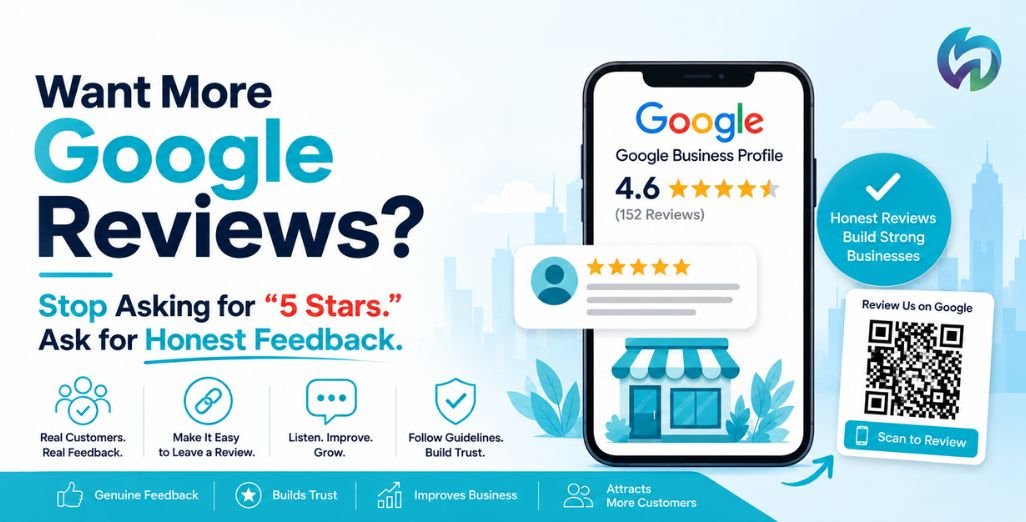
Google provides businesses with a direct review link and QR code that can be shared with customers. Google suggests using these in places such as emails, receipts, chats and physical locations.
So instead of:
“Please review us on Google.”
send:
“Thanks for choosing us. If you have a minute, we’d really appreciate your honest feedback on Google: [Review Link]”
One click is much easier than five.
For a café in Dehradun, put the QR code on the receipt.
For a hotel in Mussoorie, send the link after checkout.
For a digital agency in Uttarakhand, include it in the project handover email.
Small changes like this can make the process much more consistent.
Don’t Tell People What to Write
This is where some businesses go too far.
I’ve seen requests like:
“Please give us 5 stars and mention our excellent service.”
Don’t do that.
Your request should be for honest feedback, not a specific rating or specific wording.
You shouldn’t pressure customers to leave five stars, ask them to mention particular employees or services, or discourage them from reviewing if they had a poor experience. Google’s review policies prohibit this kind of manipulation.
A much better message is simply:
“We’d love to hear about your experience. Please leave us an honest review on Google.”
Then let the customer decide what to say.
And Please Don’t Offer a Discount for a Review
This one is straightforward.
Don’t say:
“Leave us a five-star review and get 10% off.”
And don’t change it to:
“Leave us an honest review and get a free coffee.”
It’s still an incentive for a review.
Google considers incentivized reviews fake engagement and prohibits businesses from offering or accepting incentives in exchange for reviews.
If you want more reviews, improve the process of asking for them.
Don’t pay people to manufacture them.
What If Someone Leaves a Negative Review?
This is where I think businesses often take the wrong approach.
Their first reaction is:
“How do I remove this?”
If the review violates Google’s policies, you can report it. But you can’t simply remove a genuine negative review because you don’t like what the customer said. Google makes this distinction clear in its review policies.
Sometimes the better move is to respond.
Something as simple as:
“We’re sorry your experience wasn’t what you expected. We’d like to understand what happened and see if we can make it right. Please contact our team directly.”
That’s enough.
Remember, you’re not only responding to the person who left the review.
You’re responding to every future customer who reads it.
And if several customers complain about the same thing, pay attention.
If five people mention slow service, the answer isn’t to collect twenty more reviews to push those comments down.
Fix the slow service.
Don’t Just Collect Reviews. Read Them.
This is one of the most useful things you can do with your reviews.
Look for patterns.
Maybe customers repeatedly mention:
- Friendly staff
- Slow delivery
- Easy booking
- Difficult parking
- Good communication
- Great ambience
- Expensive pricing
- Quick response times
Those comments tell you how customers actually experience your business.
They can also give you ideas for your website, social media and future content.
For example, if customers repeatedly describe your café as a good place to work, that’s useful information.
You could create content around:
“A Work-Friendly Café in Dehradun: What Customers Should Know.”
Now your reviews aren’t just reputation signals.
They’re customer research.
Build Reviews Into Your Normal Workflow
The best review strategy isn’t one that someone remembers once every three months.
Make it part of your normal customer journey.
Something like:
- Customer completes purchase
- Thank-you message
- Google review link
- Customer leaves honest feedback
- Business responds
That’s it.
You don’t need complicated automation to begin with.
For a small business, even a simple WhatsApp or email template can work.
The important thing is consistency.
A Review Message I’d Actually Send
Here’s a simple version that doesn’t sound like marketing copy:
Hi [Name], thanks for choosing [Business Name]. We hope you had a good experience. If you have a minute, we’d really appreciate an honest review on Google. Your feedback helps us understand what we’re doing well and where we can improve. [Review Link]
That’s enough.
No:
“Please give us 5 stars.”
No:
“Help us become the #1 business in Dehradun.”
No:
“Get a discount for your review.”
Just ask.
A Simple Checklist for Getting Genuine Google Reviews
Before you start asking customers for more reviews, make sure you’re doing these things:
- Ask genuine customers
- Ask soon after the customer experience
- Use a direct Google review link
- Use a QR code where it makes sense
- Ask for honest feedback
- Ask customers consistently
- Respond to reviews
- Take negative feedback seriously
- Never buy reviews
- Never offer incentives for reviews
- Never ask specifically for five stars
- Never tell customers what to write
Google’s own guidance is fairly simple: ask customers, make the process easy and let them share their genuine experience.
Good Reviews Start With a Good Customer Experience
There’s no shortcut around this.
You can have the perfect review-request message, a beautiful QR code and a well-optimized Google Business Profile.
But if the actual customer experience is poor, the reviews will eventually reflect it.
That’s why I look at reviews as more than a number.
They’re feedback from the market.
Use them to understand what customers appreciate, where your business falls short and what you can improve.
Do that consistently, make it easy for happy and unhappy customers alike to share their experience, and your review profile will grow naturally.
Need Help with Your Google Business Profile?
Reviews are only one part of local visibility.
If you’re a business owner in Dehradun or anywhere in Uttarakhand, the Nevtrino team can look at your Google Business Profile, website and local search presence and help you build a practical strategy around the customers you actually want to reach.
Visit our Contact Us page, call us, or fill out the enquiry form.
You take care of your business. We’ll take care of helping the right customers find it.